WAEC
The West African Examinations Council (WAEC) Nigeria has published updated results for the 2025 West African Senior School Certificate Examination (WASSCE) for school candidates, following the identification of grading errors that significantly impacted candidates’ performance outcomes.
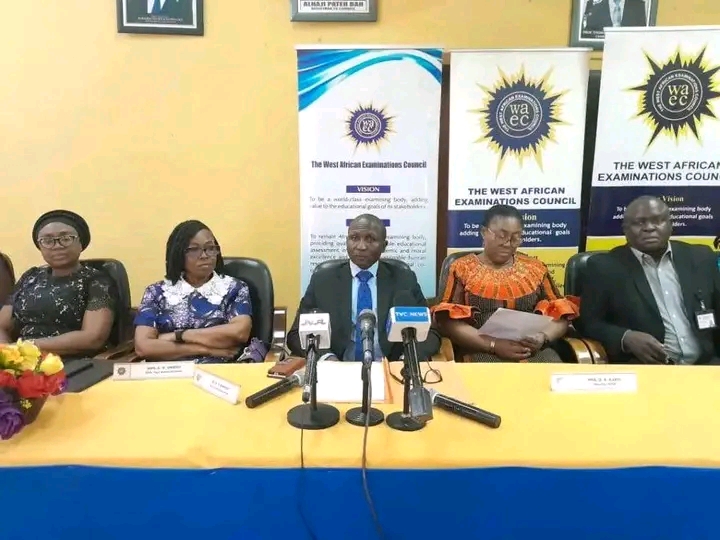
At a press conference held on Friday at WAEC’s national office in Yaba, Lagos, Dr. Amos Dangut, Head of WAEC Nigeria, acknowledged a serious error in the marking of serialised examination papers, which led to a misreporting of candidates’ scores.
“On behalf of the Registrar to Council, Management, and Staff of WAEC Nigeria, I sincerely apologize for the discrepancies found in the grading of serialised papers. This is difficult for us to admit, but it is important that we do,” Dangut said.
The council had introduced a new security measure called paper serialisation, already employed by another national examination body. However, during post-examination reviews, it was discovered that the English Language Objective Test (Paper 3) was scored using incorrect answer keys due to the wrong serialised code file being assigned.
Subjects affected by serialisation included English, Mathematics, Biology, and Economics.
“Our investigation revealed that the serialised code file used to print the English Language Objective paper was incorrect, which caused markers to apply wrong answer keys. It’s important to stress that candidates who took the exam via computer-based testing were unaffected,” Dangut explained.
After correcting the error, results show that 1,794,821 candidates, representing 91.14%, achieved credit or higher in at least five subjects, with or without English and Mathematics. Additionally, 1,239,884 candidates (62.96%) obtained five credits including English and Mathematics, a significant increase from the initially reported 38.32%.
Among these, 657,819 (53.05%) were female candidates, while 582,065 (46.95%) were male. Despite this improvement, the pass rate represents a 9.16% decline compared to the 72.12% achieved in 2024.
A total of 1,969,313 candidates sat for the exams, including those from Benin Republic, Côte d’Ivoire, and Equatorial Guinea, which follow the Nigerian curriculum. The council also accommodated 12,178 special needs candidates, including 112 visually impaired, 615 hearing impaired, 37 physically challenged, and 52 spastic/mentally challenged candidates; their results have been processed and released accordingly.
“All candidates were properly catered for throughout the examination process,” Dangut stated.
While results for 1,763,470 candidates (89.55%) have been fully processed, 205,916 candidates (10.45%) still have pending subjects due to technical issues. WAEC assured that efforts are underway to complete processing and release these results soon.
Meanwhile, the council has withheld the results of 191,053 candidates (9.7%) over allegations of examination malpractice, a reduction from the 11.92% withheld in 2024. Investigations continue, and affected candidates can file complaints through the designated WAEC complaints portal.
“WAEC remains committed to penalising all cases of examination malpractice. Collective vigilance is essential to maintain the integrity of the examination system,” Dangut stressed.
Candidates are encouraged to check their results via the official WAEC portal and apply for digital certificates, which will be issued within 48 hours after result verification. Hard copy certificates will be available within 90 days.
Dangut also reminded that candidates sponsored by state governments with outstanding debts to WAEC will not have access to their results until payments are settled. “We call on the responsible authorities to resolve these issues promptly to enable affected candidates and schools to access their results,” he urged.
He concluded with an unreserved apology to all stakeholders: “We understand the distress this situation has caused candidates, parents, teachers, school administrators, Ministries of Education, and the media. This has been a challenging period for us, and we are working tirelessly to ensure such issues do not happen again.”
WAEC expressed gratitude to the Federal Government, the Minister of Education, and state education bodies for their support throughout the review and correction process.
At a press conference held on Friday at WAEC’s national office in Yaba, Lagos, Dr. Amos Dangut, Head of WAEC Nigeria, acknowledged a serious error in the marking of serialised examination papers, which led to a misreporting of candidates’ scores.
“On behalf of the Registrar to Council, Management, and Staff of WAEC Nigeria, I sincerely apologize for the discrepancies found in the grading of serialised papers. This is difficult for us to admit, but it is important that we do,” Dangut said.
The council had introduced a new security measure called paper serialisation, already employed by another national examination body. However, during post-examination reviews, it was discovered that the English Language Objective Test (Paper 3) was scored using incorrect answer keys due to the wrong serialised code file being assigned.
Subjects affected by serialisation included English, Mathematics, Biology, and Economics.
“Our investigation revealed that the serialised code file used to print the English Language Objective paper was incorrect, which caused markers to apply wrong answer keys. It’s important to stress that candidates who took the exam via computer-based testing were unaffected,” Dangut explained.
After correcting the error, results show that 1,794,821 candidates, representing 91.14%, achieved credit or higher in at least five subjects, with or without English and Mathematics. Additionally, 1,239,884 candidates (62.96%) obtained five credits including English and Mathematics, a significant increase from the initially reported 38.32%.
Among these, 657,819 (53.05%) were female candidates, while 582,065 (46.95%) were male. Despite this improvement, the pass rate represents a 9.16% decline compared to the 72.12% achieved in 2024.
A total of 1,969,313 candidates sat for the exams, including those from Benin Republic, Côte d’Ivoire, and Equatorial Guinea, which follow the Nigerian curriculum. The council also accommodated 12,178 special needs candidates, including 112 visually impaired, 615 hearing impaired, 37 physically challenged, and 52 spastic/mentally challenged candidates; their results have been processed and released accordingly.
“All candidates were properly catered for throughout the examination process,” Dangut stated.
While results for 1,763,470 candidates (89.55%) have been fully processed, 205,916 candidates (10.45%) still have pending subjects due to technical issues. WAEC assured that efforts are underway to complete processing and release these results soon.
Meanwhile, the council has withheld the results of 191,053 candidates (9.7%) over allegations of examination malpractice, a reduction from the 11.92% withheld in 2024. Investigations continue, and affected candidates can file complaints through the designated WAEC complaints portal.
“WAEC remains committed to penalising all cases of examination malpractice. Collective vigilance is essential to maintain the integrity of the examination system,” Dangut stressed.
Candidates are encouraged to check their results via the official WAEC portal and apply for digital certificates, which will be issued within 48 hours after result verification. Hard copy certificates will be available within 90 days.
Dangut also reminded that candidates sponsored by state governments with outstanding debts to WAEC will not have access to their results until payments are settled. “We call on the responsible authorities to resolve these issues promptly to enable affected candidates and schools to access their results,” he urged.
He concluded with an unreserved apology to all stakeholders: “We understand the distress this situation has caused candidates, parents, teachers, school administrators, Ministries of Education, and the media. This has been a challenging period for us, and we are working tirelessly to ensure such issues do not happen again.”
WAEC expressed gratitude to the Federal Government, the Minister of Education, and state education bodies for their support throughout the review and correction process.